
Overview
The phrases “gross” and “nett” are commonly used in personal finance, commercial accounting, and even daily budgeting. At first glance, they may appear to be interchangeable, yet they actually reflect quite diverse ideas. Knowing the difference between gross and nett is essential for anybody managing their personal income and expenses, not just those working in business or finance.
Understanding the subtleties of gross vs. nett is crucial whether you’re examining a paycheck, figuring out how profitable your firm is, or assessing the financial standing of an organisation. From salaries and income tax to corporate finance and investment plans, this essay delves deeply into these concepts, their distinctions, and their significance in a variety of scenarios.
1. Identifying Nett and Gross
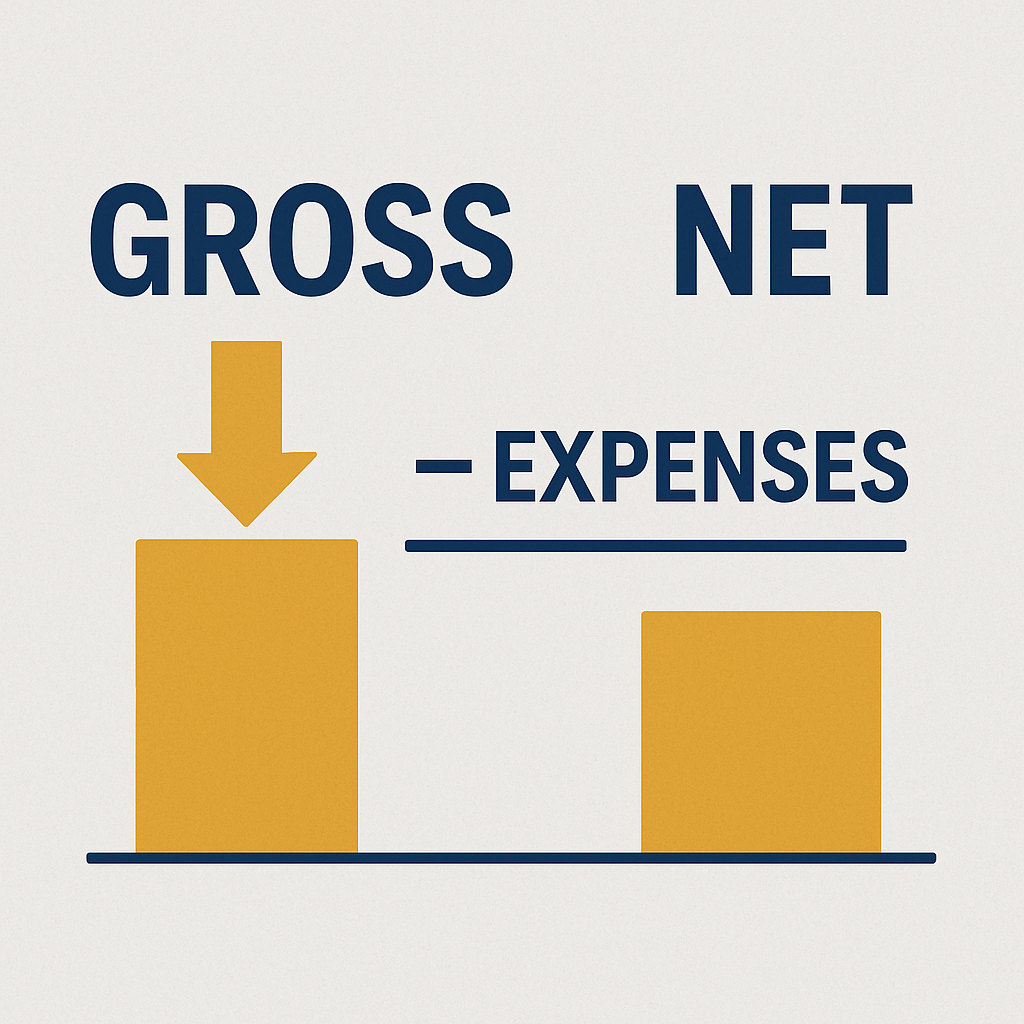
Fundamentally, “gross” means the entire amount before any deductions are made, and “nett” is the amount that remains after all deductions have been made. Whether discussing gross income versus nett income, gross profit against nett profit, or gross weight versus nett weight, these definitions are applicable in all domains.
Planning, budgeting, and precise financial analysis all depend on knowing which figure you’re looking at.
2. Personal Finance: Gross vs. Nett Income
Gross income, as used in personal finance, is the sum of earnings before all deductions, including taxes, insurance, and retirement contributions. Wages, bonuses, dividends, rental income, and any other sources of income are all included in this.
Conversely, nett income—basically, your take-home pay—is what remains after all deductions have been made. For instance, your nett income is $3,800 if your gross monthly salary is $5,000 and your deductions come to $1,200.
Since your nett income represents the actual amount you can spend or save, knowing it is crucial for creating a budget.
3. The Viewpoint of the Employee on Gross vs. Nett Salary
Job offers frequently include a gross pay, which is the total income provided before deductions. However, depending on tax rates, benefit contributions, and other statutory deductions, your nett salary—what you get in your bank account—may be much less.
When comparing job offers, assessing pay increases, or budgeting for monthly spending, this distinction is essential. Setting reasonable financial expectations is facilitated by understanding how to calculate nett pay from gross salary.
4. Business Context: Gross vs. Nett Revenue
Gross revenue, as used in business, is the total amount of money made from sales or services before any costs are subtracted. All income from main and secondary sources is included in this.
Returns, discounts, and allowances are deducted from gross revenue to arrive at nett revenue, also known as nett sales. Particularly in businesses with high return rates or pricing adjustments, it gives a more accurate depiction of actual income.
5. Comparing Gross and Nett Profit
The two most important measures in corporate performance analysis are gross and nett profits:
Revenue less Cost of Goods Sold (COGS) equals gross profit.
It shows the amount of money a business makes after subtracting the direct expenses of making items or rendering services.
Gross profit less operating costs, taxes, and interest equals nett profit.
Often known as the “bottom line,” this is the ultimate profit amount following the deduction of all corporate expenses.
While gross profit aids in assessing production efficiency, nett profit offers a more thorough understanding of profitability.
6. The Significance of Distinction in Business
A company’s financial health may be misinterpreted as a result of confusing gross and nett data. For instance, a company may have a large gross revenue but a very low nett profit because of debt or excessive operating expenses.
Both numbers are used by stakeholders, investors, and financial analysts to evaluate performance. Nett income is particularly crucial for assessing management effectiveness and long-term viability.
7. Budgeting using Gross vs. Nett
It might be deceptive to base a budget, whether personal or business, solely on gross revenue. To make sure you’re planning with the real money you have available for expenditure, budgets should be based on nett income.
For instance, it might not be feasible to save 20% of your gross pay if a significant amount is withheld for taxes and benefits. Instead, use your nett income to determine your savings objectives.
8. Nett Margin vs. Gross
Profitability is assessed using financial ratios such as nett margin and gross margin:
(Gross Profit / Revenue) × 100 = Gross Margin (%)
(Nett Profit / Revenue) × 100 = Nett Margin (%)
While nett margin indicates how much of every dollar earned turns into profit after all costs are paid, gross margin indicates how well a business produces its items.
Analysts and investors use these measures to compare businesses in the same industry.
9. Effect on Taxation
Depending on their revenue, both individuals and businesses must pay taxes. On the other hand, taxable income usually approaches nett income more closely than gross income. Tax credits, exemptions, and deductions lower gross income for people, resulting in taxable nett income.
Before determining taxes on nett income, businesses can deduct interest, losses, and operating expenses. By being aware of this difference, tax planning techniques can be improved and overestimation of tax obligations can be prevented.
10. Weight in Gross versus Nett
The gross vs. nett difference is also seen in shipping and logistics outside of finance:
The product’s weight plus the weight of the container, packing, etc. is its gross weight.
Nett Weight is equal to the product’s weight alone.
Particularly in international trade, this distinction has an impact on pricing, customs charges, and shipping expenses.
11. Investment Analysis Applications
Gross and nett returns aid investors in weighing risk and reward when evaluating investment opportunities:
Total earnings before fees, taxes, or inflation is known as the gross return.
Nett Return: Actual profits following all costs and modifications.
In order to properly assess the profitability of investments, investors need to take nett returns into account. A lower-than-expected nett return could be the consequence of a high gross return with significant fees or taxes.
12. Function in Sales and Marketing
Marketers frequently contrast gross and nett leads:
Gross Leads: All campaign-generated contacts
Nett Leads: Qualified leads with a high conversion rate
Knowing this makes it easier to allocate resources effectively and increase the return on investment of marketing initiatives.
13. Significance in Credit and Loan Assessments
When assessing loan applications, lenders take into account both gross and nett incomes. A more accurate indicator of a borrower’s capacity to repay debt is provided by debt-to-income ratios, which are normally computed using nett income.
By mentioning their gross income, applicants frequently overstate their borrowing capabilities. Being realistic about one’s nett income aids in debt avoidance and improved financial planning.
14. Making Strategic Business Decisions
Executives base important decisions on gross and nett metrics:
Should the company add more products to its lineup?
After all expenses, is a service profitable?
Where may nett profitability be increased through cost reductions?
Nett numbers show reality, but gross measurements show possibility. A thoughtful approach takes both into account.
15. Gross vs Nett in the Gig and Freelance Economy
Gross pay may appear great to gig workers, freelancers, or contractors until taxes, platform fees, and other business expenditures are subtracted. Monitoring nett income is crucial for comprehending true revenues and efficiently managing money.
For example, after marketing, self-employment taxes, and software subscriptions, a freelance graphic designer making $10,000 per month may receive much less money.
16. Common Errors and Misconceptions
Planning or forecasting based on gross data is one of the most common errors made by both people and businesses. For example:
Without knowing the true take-home income, new hires accept a job offer based on the gross wage.
Startups don’t disclose low nett profits or high burn rates when they pitch investors on high gross revenue.
Miscommunication, bad choices, and financial mismanagement are avoided when gross and nett terms are clear and transparent.
In conclusion
A basic idea in business, money, and daily life, the distinction between gross and nett is far more than just a technicality. Knowing these terminology enables you to make strategic, practical, and well-informed judgements on everything from calculating your paycheck to examining a company’s financial performance.
While nett data show the reality of performance and sustainability, gross figures tell the story of promise. Always keep in mind that what you keep matters more than what you make or sell, whether you’re budgeting at home, starting a business, or making retirement plans.