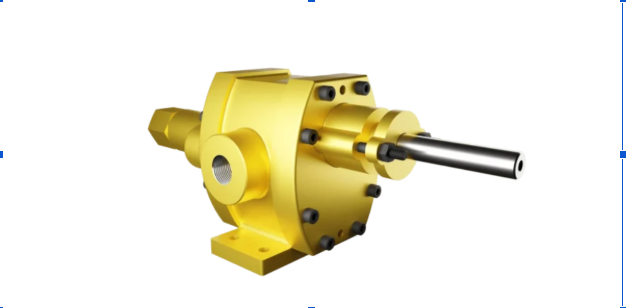

Selecting the right positive displacement pump for a fluid transfer application is a decision that significantly affects system reliability, maintenance costs, and energy efficiency. Two pump types that appear frequently in industrial fluid transfer applications are the double diaphragm pump and theRotary Drive Gear pump, each with distinct operating principles, strengths, and limitations. Understanding when each is the right choice and what factors should drive the decision, helps engineers avoid the common mistake of specifying the wrong pump type for a demanding application.
How the Rotary Gear Pump Works
A rotary gear pump uses two intermeshing gears, typically spur, helical, or internal gear configurations, rotating within a close-clearance casing to trap fluid between the gear teeth and the casing wall and transfer it from the inlet to the outlet port. The displacement per revolution is highly consistent, making the Rotary Drive Gear pump a fundamentally positive displacement device with predictable, metered flow output.
The Rotary Drive Gear pump is well suited to:
- Viscous liquids, where centrifugal pumps lose efficiency rapidly
- Applications requiring smooth, pulsation-free flow
- Metered fluid transfer where a consistent volume per revolution is important
- Lubricious fluids that provide adequate lubrication to the gear teeth and casing
How the AODD Pump Works
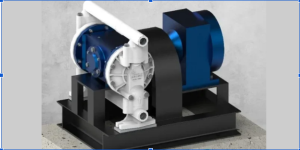
An AODD pump, air-operated double diaphragm pump, uses alternating diaphragm strokes driven by compressed air to transfer fluid through ball check valves. The two chambers operate 180 degrees out of phase, providing a relatively continuous flow with some pulsation.
The Double Diaphragm Pump excels in applications involving the following:
- Abrasive or particle-laden fluids that would damage close-clearance gear pump internals
- Chemically aggressive fluids where diaphragm material selection eliminates metallic wetted parts
- Shear-sensitive products where the gentle, low-speed pumping action minimises degradation
- Applications requiring dry-run capability without damage
- Hazardous area installations where electrical drives are undesirable
Comparing the Two for Key Application Parameters
| Application Parameter | Rotary Drive Gear Pump | AODD Pump |
| Viscous fluids | Excellent: efficiency improves with viscosity | Good: handles high viscosity but lower efficiency |
| Abrasive fluids | Poor: solids damage close-clearance gears | Excellent: no close clearances to damage |
| Flow pulsation | Low: near-continuous smooth flow | Moderate: inherent pulsation from diaphragm action |
| Self-priming capability | Good | Excellent |
| Dry-run tolerance | Poor: gears require fluid lubrication | Excellent |
| Hazardous area suitability | Requires ATEX motor | Inherently suitable with compressed air drive |
When the Rotary Gear Pump Is the Clearly Better Choice
The rotary gear pump should be specified when the application involves a clean, lubricious, viscous fluid that would reduce the efficiency of a centrifugal pump to unacceptable levels. Classic applications include:
- Fuel oil transfer in industrial heating systems
- Hydraulic oil circulation in machinery
- Lubricating oil transfer in engine and gearbox systems
- Bitumen and heavy crude oil transfer at elevated temperature
- Polymer and resin transfer in manufacturing processes
In these applications, the Rotary Drive Gear pump provides smooth, efficient, and consistent flow at the pressure levels required, with good long-term reliability provided the fluid itself is clean and lubricious.
When the AODD Pump Is the Better Specification
Choose an AODD pump when the fluid contains particles, is chemically aggressive, or when dry-run capability is important. The elimination of metallic wetted parts through appropriate diaphragm and ball valve material selection makes Double Diaphragm Pumps the standard choice for many chemical transfer applications.
Applications where double diaphragm pumps are routinely specified include the following:
- Transfer of acids and bases in chemical plants
- Ceramic slurry transfer in tile and sanitaryware manufacturing
- Paint and coating transfer where shear sensitivity and solvent resistance matter
- Sump and pit emptying where the pump may run dry intermittently
Maintenance Considerations for Each Type
Both pump types have maintenance requirements that should be factored into the total cost of ownership assessment:
Rotary Drive Gear pump maintenance focuses on gear and bearing wear, shaft seal condition, and the relief valve that protects against dead-heading. Wear rates depend strongly on fluid cleanliness and lubricity.
AODD pump maintenance centres on diaphragm condition, ball check valve seating, and air valve operation. Diaphragm replacement is routine and straightforward, but the frequency depends on the fluid being handled and operating conditions.
Conclusion
Choosing between a Rotary Drive Gear pump and a double diaphragm pump requires an honest assessment of the fluid characteristics, process conditions, and operational requirements of the specific application. Neither pump type is universally superior; each excels in the conditions it is designed for. NND Oil & Gas provides engineering guidance and supply of both Rotary Drive Gear pumps and double diaphragm pumps across industrial and oil and gas applications, ensuring that every pump specified is correctly matched to the duty it is required to perform.